

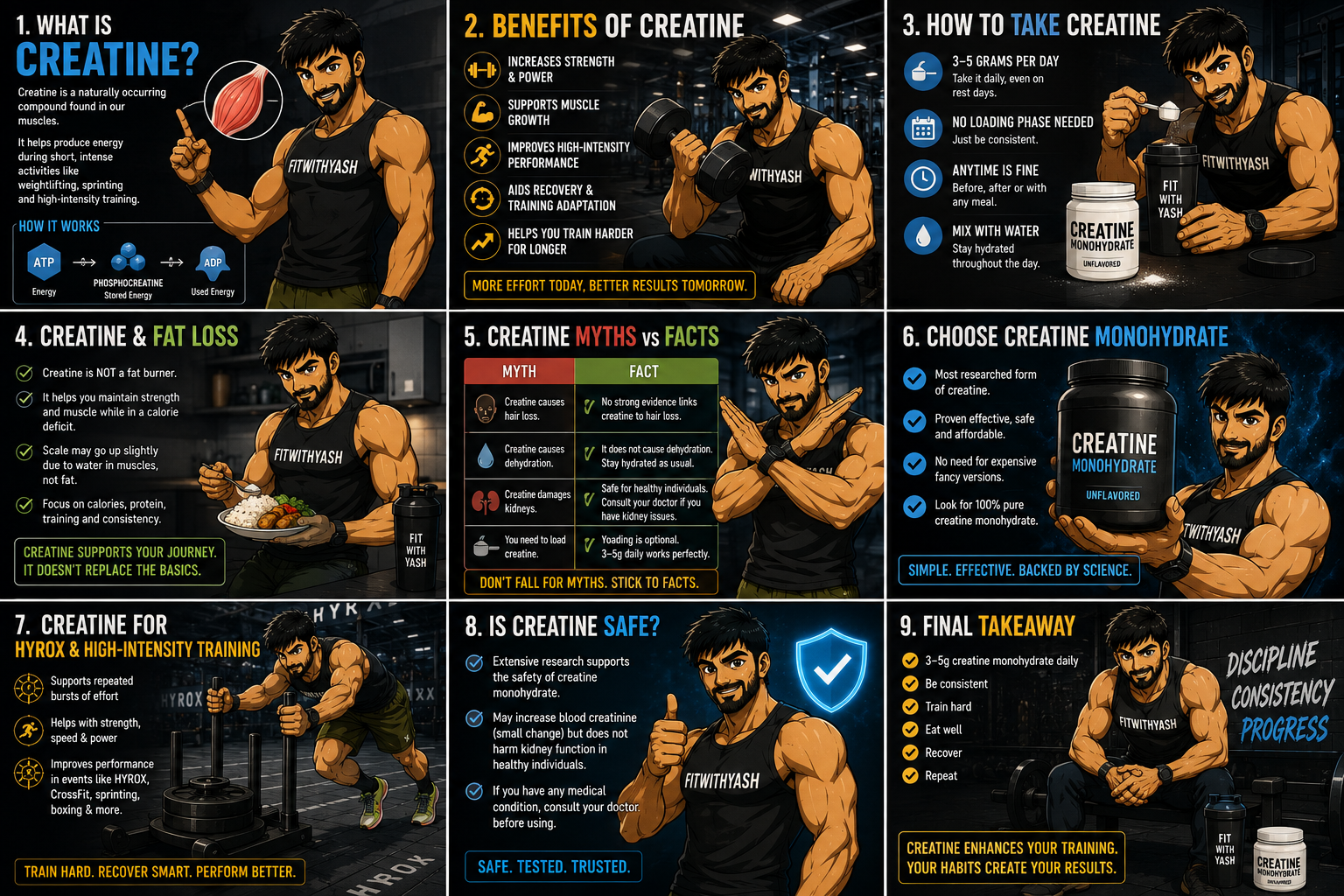
Creatine is one of the most researched and widely used sports supplements in the world. Unlike many supplements that make big promises with limited evidence, creatine has a strong body of research supporting its ability to improve high-intensity exercise performance, strength, and training adaptations.
But what exactly is creatine? Is it safe? Does it cause hair loss or kidney damage? Do you need a loading phase? And most importantly, should you take it?
Let’s break it down.
What Is Creatine?
Creatine is a naturally occurring compound found primarily in our muscles. The body produces creatine naturally, and we also obtain some from foods such as meat and fish.
Inside the muscles, creatine is stored largely as phosphocreatine. During short, intense activities such as weightlifting, sprinting, jumping, or repeated high-intensity efforts phosphocreatine helps rapidly regenerate ATP, the body’s immediate energy currency.
In simple terms:
More available creatine → greater phosphocreatine availability → better ability to perform repeated high-intensity efforts.
That doesn’t mean creatine gives you an instant energy boost like caffeine. Its benefits come from gradually increasing the amount of creatine stored in your muscles.
Why Is Creatine Important?
1. It Can Improve Strength and Power
One of the biggest reasons athletes and gym-goers use creatine is improved performance during high-intensity exercise.
By increasing muscle creatine stores, supplementation can help support repeated efforts such as heavy sets, sprints, jumps, and other explosive activities. Over time, being able to perform slightly more work can contribute to better training adaptations.
For example, if you normally manage:
100 kg × 5 reps
and creatine helps you consistently squeeze out an additional rep or maintain performance across multiple sets, that extra training volume can become meaningful over weeks and months.
Creatine isn’t a replacement for hard training, it can help you get more out of your training.
2. It Supports Muscle Growth
Creatine itself isn’t a magic muscle-building supplement.
Instead, it can support muscle growth indirectly by helping you train harder and maintain performance.
Creatine supplementation also increases water stored within muscle cells, which can cause body weight to increase during the initial period of supplementation. This isn’t the same thing as gaining body fat.
Over the long term, improvements in training performance can contribute to greater increases in lean mass when combined with appropriate resistance training and nutrition.
3. It Can Help With High-Intensity Sports
Creatine isn’t only for bodybuilders.
It can be particularly useful for activities involving repeated bursts of intense effort, including:
- Weight training
- Sprinting
- CrossFit
- Hyrox
- Boxing
- Wrestling
- Football
- Basketball
- Short-distance running
- Explosive strength training
If your sport repeatedly asks you to go hard, recover, and go hard again, creatine may be useful.
4. Creatine May Support Recovery and Training Adaptation
Research has also investigated creatine’s potential role beyond immediate exercise performance, including recovery and rehabilitation. The evidence is strongest for its role in exercise performance and training adaptations, while other applications continue to be researched.
This is important because fitness isn’t about having one great workout.
It’s about consistently performing quality workouts over months and years.
Creatine and Fat Loss: Does It Help?
This is where many people get confused.
Creatine is not a fat burner.
It doesn’t directly increase fat loss in the way that a calorie deficit does.
If your goal is fat loss, your priorities should still be:
- Calorie control
- Adequate protein
- Resistance training
- Daily physical activity
- Good sleep
- Consistency
Creatine can still be useful during a fat-loss phase because maintaining strength and muscle mass becomes especially important when you’re eating fewer calories.
However, don’t be surprised if the scale goes up slightly after starting creatine. This can happen because of increased water stored in the muscles not because creatine suddenly caused body-fat gain.
So if you’re tracking fat loss, don’t judge your progress solely by the weighing scale.
How Much Creatine Should You Take?
For most healthy adults, 3–5 grams of creatine monohydrate per day is a simple and practical approach.
You don’t need to complicate it.
You can take it:
- Before your workout
- After your workout
- With breakfast
- With lunch
- At another convenient time
The most important thing is consistent daily intake, rather than obsessing over the exact timing.
Do You Need a Loading Phase?
No.
A common loading protocol is around 20 g per day for about five to seven days, usually divided into several smaller doses, followed by a maintenance dose.
Loading can saturate muscle creatine stores faster.
But if you don’t want to load, simply taking 3–5 g every day will gradually increase your muscle creatine stores.
For most people, the simpler approach is easier to follow.
Which Creatine Should You Buy?
If you’re looking for a creatine supplement, creatine monohydrate is the obvious starting point.
It is the most extensively studied form of creatine, and research has not established that expensive alternative forms provide superior performance or body-composition benefits compared with creatine monohydrate.
You don’t necessarily need:
- Creatine HCL
- Creatine ethyl ester
- Creatine blends
- Fancy “advanced” creatine formulas
A simple, reputable 100% creatine monohydrate product is generally sufficient.
Is Creatine Safe?
For healthy adults, the evidence generally supports creatine monohydrate as a well-tolerated supplement when used appropriately.
One important point is that creatine supplementation can cause a small increase in blood creatinine, which is a breakdown product related to creatine metabolism. This does not automatically mean that your kidneys are being damaged.
A 2026 systematic review and meta-analysis found that creatine supplementation was associated with an increase in serum creatinine but did not find a significant change in estimated glomerular filtration rate (eGFR), a commonly used measure of kidney function. The authors noted that more long-term research is still needed.
If you have kidney disease, reduced kidney function, or another medical condition, don’t start creatine without discussing it with your doctor.
Does Creatine Cause Hair Loss?
This is one of the most common questions about creatine.
The concern largely comes from limited research involving a marker associated with DHT, rather than strong evidence demonstrating that creatine supplementation directly causes hair loss.
At present, there isn’t convincing clinical evidence establishing creatine as a cause of hair loss.
If you are experiencing significant hair loss, it’s better to discuss it with a dermatologist rather than automatically blaming creatine.
Does Creatine Cause Dehydration?
Another common myth is that creatine causes dehydration and muscle cramps.
Current evidence does not support the idea that normal creatine supplementation inherently causes dehydration in healthy individuals. Research has even examined potential roles for creatine in hydration and thermoregulation.
That said, hydration still matters, especially if you’re training hard, sweating heavily, or exercising in a hot environment.
Drink enough fluids according to your thirst, activity level, climate, and individual needs.
Common Mistakes People Make With Creatine
Taking it only on workout days
Creatine works by increasing muscle stores over time.
Taking it only when you train isn’t necessary.
Better: Take it consistently every day.
Taking huge doses
More isn’t automatically better.
For most people, 3–5 g per day is enough for regular supplementation.
Expecting immediate results
Creatine isn’t a pre-workout stimulant.
You shouldn’t expect to feel an instant “kick.”
Its benefits come from maintaining elevated muscle creatine stores over time.
Buying the most expensive version
A higher price doesn’t automatically mean better results.
Start with a reputable creatine monohydrate product.
Thinking creatine replaces good nutrition
Creatine can’t compensate for:
- Poor diet
- Insufficient protein
- Inconsistent training
- Poor sleep
- Lack of recovery
Think of creatine as an addition to a good fitness routine not a substitute for one.
Who Can Benefit From Creatine?
Creatine can be particularly useful for people who participate in resistance training or high-intensity sports.
It may be worth considering if you:
- Want to improve strength
- Want to increase training performance
- Are trying to build muscle
- Participate in high-intensity sports
- Perform repeated sprint or explosive activities
- Want a simple, well-researched sports supplement
However, supplementation isn’t mandatory.
You can build muscle, lose fat, become stronger, and improve your fitness without taking creatine.
My Simple Take on Creatine
If you’re a healthy adult who regularly trains and wants to improve strength, muscle development, or high-intensity exercise performance, creatine monohydrate is one of the few supplements that deserves serious consideration.
You don’t need a complicated protocol.
3–5 g of creatine monohydrate every day + progressive training + sufficient protein + good nutrition + adequate sleep = a much more useful strategy than chasing the latest supplement trend.
And remember:
Creatine can enhance your training. It cannot replace your training.
The supplement is only one small piece of the puzzle.
Your workout consistency, nutrition, recovery, and patience will always matter more.
Final Takeaway
Creatine isn’t magic and that’s exactly why it’s so interesting.
It is a naturally occurring compound, extensively studied as a sports supplement, and has strong evidence supporting improvements in high-intensity exercise performance and training adaptations.
For most healthy adults, creatine monohydrate at 3–5 g daily is a simple approach.
If you’re serious about your training, it’s not a supplement you need but it is one of the supplements with the strongest evidence behind it.
Train hard. Eat well. Recover properly. And let creatine do what it’s supposed to do: support the work you’re already putting in.
Disclaimer: This article is for educational purposes and isn’t a substitute for individualized medical advice. People with kidney disease, other medical conditions, or those taking medications should consult a qualified healthcare professional before using creatine.



Leave a Reply