

Losing body fat doesn’t require starving yourself, skipping every food you enjoy, or surviving on salads and black coffee.
At the center of sustainable fat loss is a simple concept: a calorie deficit.
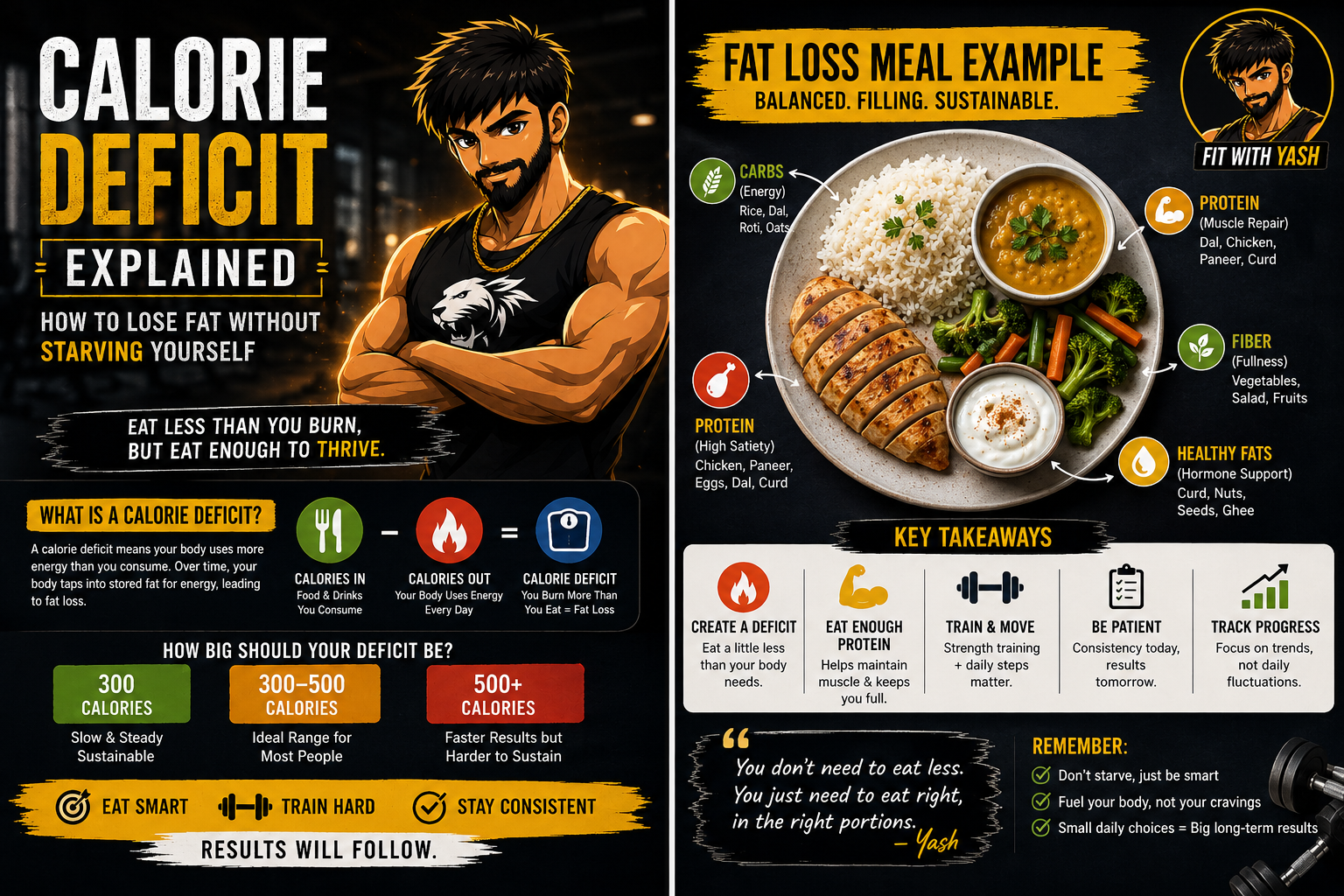
A calorie deficit means your body is using more energy than you consume through food and drinks. When this happens consistently over time, your body needs to use stored energy, which can result in weight loss.
But there’s an important distinction between eating less and eating too little.
A well-planned calorie deficit should help you lose fat while still giving you enough food, protein, nutrients, and energy to train, recover, and live normally.
In this guide, we’ll break down what a calorie deficit is, how to create one, how much you should eat, and how to avoid the common mistakes that make dieting unnecessarily difficult.
What Is a Calorie Deficit?
Calories are a measurement of energy.
Your body uses energy throughout the day to keep you alive and perform everything from breathing and digesting food to walking, working, exercising, and even sleeping.
Your total daily energy expenditure (TDEE) is influenced by several factors:
- Your basal metabolic rate (BMR)
- Daily movement and activity
- Exercise
- Digestion
- Body size and composition
- Age and other individual factors
If you consistently consume approximately the same number of calories that your body uses, your body weight tends to remain relatively stable.
If you consume more energy than you use, you have a calorie surplus.
If you consume less energy than you use, you have a calorie deficit.
For fat loss, the goal is generally to maintain a manageable calorie deficit over time.
A simple example
Imagine your body uses around 2,400 calories per day.
If you eat:
- 2,400 calories → roughly maintenance
- 2,200 calories → roughly 200-calorie deficit
- 2,000 calories → roughly 400-calorie deficit
- 1,800 calories → roughly 600-calorie deficit
These numbers are only an example. Your actual calorie needs will be different.
Why Does a Calorie Deficit Cause Fat Loss?
Your body needs energy to function.
When the energy coming from food isn’t enough to cover your energy expenditure, your body can draw on stored energy.
Over time, this can lead to a reduction in body weight and, when the diet and training program are well designed, a meaningful reduction in body fat.
However, the number on the scale isn’t identical to body fat.
Your weight can fluctuate because of:
- Water retention
- Glycogen
- Food in your digestive system
- Sodium intake
- Hormonal changes
- Training-related inflammation
This is why looking at your long-term trend is much more useful than judging your progress from one morning’s weigh-in.
How Big Should Your Calorie Deficit Be?
This is where many people make dieting unnecessarily difficult.
A bigger deficit isn’t automatically better.
You might lose weight faster with a very aggressive deficit, but you may also experience:
- Increased hunger
- Lower energy
- Poorer workout performance
- Difficulty recovering
- Reduced adherence
- Greater risk of losing lean mass
- Increased cravings and overeating
For many people, a moderate calorie deficit is easier to maintain.
A commonly used starting point is around 300–500 calories below estimated maintenance, followed by adjustments based on your actual progress.
The right deficit depends on your body size, activity level, goals, training, and individual circumstances.
Think of fat loss as a long-term process rather than a race.
How Do You Calculate Your Calorie Needs?
The first step is estimating your maintenance calories.
One common approach is:
Step 1: Estimate your BMR
Your basal metabolic rate represents the approximate energy your body requires at rest.
A commonly used equation is the Mifflin-St Jeor equation.
For men:
BMR = (10 × weight in kg) + (6.25 × height in cm) − (5 × age) + 5
For women:
BMR = (10 × weight in kg) + (6.25 × height in cm) − (5 × age) − 161
This gives you an estimate, not a perfect measurement.
Step 2: Account for activity
Your maintenance calories are higher than your BMR because you move and perform activities throughout the day.
You can estimate TDEE by multiplying BMR by an activity factor.
For example:
- Sedentary → around 1.2
- Lightly active → around 1.375
- Moderately active → around 1.55
- Very active → around 1.725
These are rough estimates, so don’t treat the resulting number as an exact prescription.
Step 3: Create a moderate deficit
Once you have an estimated maintenance level, you can start with a modest reduction.
For example, if your estimated maintenance is 2,400 calories:
2,400 − 400 = 2,000 calories/day
You could then monitor your weight trend and adjust if necessary.
You Don’t Need to Eat Tiny Meals
One of the biggest misconceptions about fat loss is that you have to eat very little.
You don’t.
The goal is to find foods that provide a lot of satiety and nutrition for relatively few calories.
Foods that can make a calorie deficit easier include:
Protein-rich foods
- Eggs
- Chicken
- Fish
- Greek yogurt/curd
- Paneer
- Tofu
- Soy products
- Dal and legumes
High-volume foods
- Vegetables
- Fruits
- Soups
- Salads
- Potatoes
- Whole grains
Smart carbohydrate choices
You don’t have to eliminate rice, roti, potatoes, or other carbohydrates to lose fat.
Instead, pay attention to portions and build balanced meals.
For example:
Rice + dal + vegetables + a protein source
can be a perfectly reasonable fat-loss meal.
The important factor is how your overall food intake fits into your calorie target.
Protein Is Your Friend During Fat Loss
If you’re trying to lose fat while maintaining muscle, protein deserves special attention.
Protein can help with:
- Maintaining muscle during weight loss
- Recovery from resistance training
- Feeling fuller after meals
- Supporting normal body functions
A practical target for many people who train is roughly 1.6–2.2 g of protein per kg of body weight per day, although individual needs can vary.
For example, someone weighing 70 kg might aim somewhere around:
112–154 g protein/day
You don’t necessarily need to hit the exact same number every day.
Consistency over time matters more.
You Can Still Eat Your Favorite Foods
A sustainable diet shouldn’t make you feel like you’re being punished.
Pizza, chocolate, ice cream, burgers, and other foods can potentially fit into a fat-loss diet.
The key is portion control and overall calorie intake.
For example, instead of turning one meal into an all-or-nothing cheat day, you could enjoy a reasonable portion and continue with your normal meals afterward.
This is one reason I prefer the idea of a flexible diet over a diet based on completely forbidden foods.
When everything is forbidden, cravings can become much harder to manage.
What About Sugar?
You don’t necessarily have to completely eliminate sugar to lose fat.
Added sugar can make it easier to consume a lot of calories without feeling very full, especially when it comes from sugary drinks and highly processed foods.
Reducing these foods can therefore be useful.
But there’s an important difference between:
“Sugar makes fat loss impossible.”
and
“Eating a lot of high-calorie sugary foods can make maintaining a calorie deficit harder.”
The second statement is much more accurate.
You can lose fat while occasionally eating something sweet.
Don’t Drink Your Calories Without Realizing It
Liquid calories can be surprisingly easy to overlook.
Examples include:
- Soft drinks
- Sweetened coffee
- Milkshakes
- Sugary juices
- High-calorie smoothies
- Alcohol
These drinks may provide significant calories without being as filling as a solid meal.
If you’re struggling to maintain a calorie deficit, checking your drinks is an easy place to start.
Water, unsweetened tea, and other low- or zero-calorie drinks can make staying within your calorie target easier.
Strength Training Can Help You Preserve Muscle
If your goal isn’t simply to become lighter but to improve your body composition, resistance training is extremely useful.
During a calorie deficit, your body weight decreases.
But ideally, you want a large proportion of that weight loss to come from body fat rather than muscle.
Resistance training provides your body with a reason to maintain muscle.
A basic strength-training routine can include movements such as:
- Squats
- Deadlifts or hip hinges
- Bench press
- Rows
- Overhead press
- Pull-ups or pulldowns
- Lunges
You don’t need to perform every exercise.
The important thing is having a structured program and gradually improving your performance where possible.
Walking Is Underrated
You don’t need to spend hours on a treadmill to burn calories.
Increasing your daily movement can be a surprisingly effective way to increase energy expenditure.
Walking is:
- Accessible
- Low impact for most people
- Easy to recover from
- Simple to fit into your day
If you currently average 4,000 steps per day, increasing that gradually can be more realistic than suddenly trying to walk 15,000–20,000 steps every day.
The best activity is often the one you can consistently perform.
How Fast Should You Lose Weight?
There isn’t one perfect rate for everyone.
A commonly used general target is approximately 0.5–1% of body weight per week, particularly for people with more body fat to lose.
However, the appropriate rate depends on the individual.
As you become leaner, aggressive dieting can become increasingly difficult and may increase the risk of losing lean mass.
Don’t judge your progress based on a single week.
Instead, look at your weight trend over several weeks.
Why Has My Weight Stopped Going Down?
This is one of the most common frustrations during a diet.
You start eating less.
Your weight drops.
Then suddenly…
Nothing.
Before dramatically cutting calories again, remember that scale weight can be affected by water and other factors.
Ask yourself:
- Has it actually been several weeks?
- Are you tracking your food consistently?
- Have your portions increased?
- Are weekends significantly different?
- Has your activity decreased?
- Are you retaining more water?
- Are you eating more sodium or carbohydrates than usual?
A short-term plateau doesn’t necessarily mean your fat loss has stopped.
Your maintenance calories can also change
As you lose weight, your body generally requires fewer calories.
A person weighing 90 kg may burn more calories during daily activity than the same person weighing 70 kg.
This means a calorie target that worked earlier in your journey may eventually need adjustment.
Don’t Automatically Eat Back Every Exercise Calorie
Fitness watches and cardio machines can provide estimates of calories burned.
But these numbers aren’t perfectly accurate.
If your watch says you burned 600 calories during a workout, that doesn’t necessarily mean you should eat an extra 600 calories.
Instead, use your actual progress as feedback.
If you’re consistently losing weight at an appropriate rate and your energy and training are good, your plan is probably working.
The Most Common Calorie Deficit Mistakes
1. Cutting calories too aggressively
Eating as little as possible isn’t the goal.
A sustainable deficit is usually more useful than an extreme one.
2. Ignoring protein
A calorie deficit without sufficient attention to protein and resistance training can make maintaining muscle more difficult.
3. Treating weekends differently
Eating carefully Monday through Friday and then dramatically overeating on Saturday and Sunday can erase much of your weekly deficit.
4. Drinking lots of calories
Liquid calories can add up quickly.
5. Obsessing over the scale
Your weight naturally fluctuates.
Focus on trends.
6. Eliminating entire food groups unnecessarily
You don’t have to eliminate carbohydrates or your favorite foods to lose fat.
7. Expecting immediate results
Fat loss takes time.
Consistency beats perfection.
A Simple Calorie Deficit Strategy
If you’re a beginner, don’t make your diet unnecessarily complicated.
Try this:
Step 1: Estimate your maintenance calories
Use a calorie calculator or a TDEE estimate as your starting point.
Step 2: Choose a moderate deficit
Start around 300–500 calories below estimated maintenance.
Step 3: Prioritize protein
Build meals around protein-rich foods.
Step 4: Eat plenty of vegetables and fruit
They can help you build filling, nutrient-dense meals.
Step 5: Keep lifting
Resistance training can help you maintain muscle while losing weight.
Step 6: Increase daily movement
Walking is a simple way to increase activity.
Step 7: Track your progress
Track your body weight and look at the trend rather than individual measurements.
Step 8: Adjust slowly
If progress has genuinely stalled for several weeks, make a small adjustment rather than drastically cutting calories.
Example of a Simple Fat-Loss Day
Here’s an example of what a balanced day might look like:
Breakfast
Eggs + vegetables + fruit + toast
Lunch
Rice or roti + chicken/paneer/tofu + dal + vegetables
Snack
Curd/Greek yogurt + fruit
Dinner
Roti or rice + a protein source + vegetables
Optional treat
A small portion of chocolate, dessert, or another food you enjoy
The exact foods and quantities should be adjusted according to your calorie and protein requirements.
The Goal Is to Build a Diet You Can Live With
The best fat-loss diet isn’t necessarily the one that promises the fastest transformation.
It’s the one you can actually follow.
You should be able to:
- Eat foods you enjoy
- Train effectively
- Get enough protein
- Sleep properly
- Socialize
- Have occasional treats
- Maintain your diet for months rather than days
If your diet is so restrictive that you constantly think about food, feel exhausted, or repeatedly binge after periods of restriction, it may be time to rethink the approach.
Fat loss should be challenging, but it shouldn’t require you to hate every day of the process.
Final Thoughts
A calorie deficit is the foundation of fat loss, but starving yourself isn’t.
Start with a realistic calorie target, prioritize protein and nutrient-dense foods, keep strength training, stay active, and give your body enough time to respond.
You don’t need a perfect diet.
You need a consistent one.
If you can create a moderate calorie deficit while eating satisfying meals and maintaining your training, you can make steady progress without turning fitness into a daily battle.
And remember: your goal isn’t just to lose weight. It’s to build habits that help you stay healthy and maintain your results after the weight is gone.
Disclaimer: This article is for general educational purposes and isn’t a substitute for individualized medical or nutritional advice. If you have a medical condition, are pregnant, have a history of disordered eating, or have specific dietary requirements, consult an appropriately qualified healthcare professional before making major changes to your diet.




Leave a Reply