

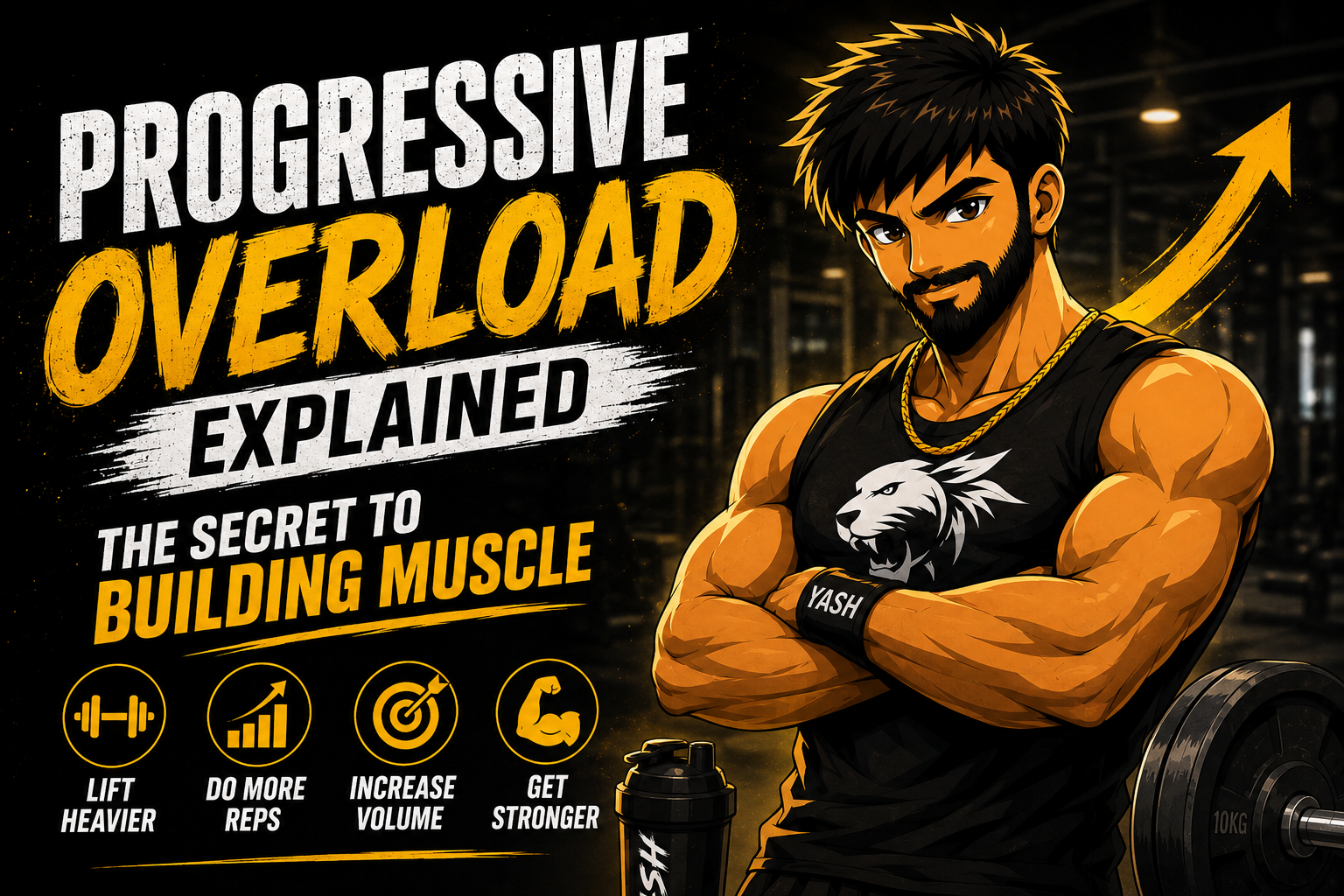
Building muscle isn’t just about going to the gym and lifting weights. If you want consistent results, your workouts need to become progressively more challenging over time.
That’s where progressive overload comes in.
Progressive overload is one of the most important principles of strength training and muscle growth. It simply means gradually increasing the demands placed on your muscles so your body has a reason to adapt, become stronger, and build more muscle.
But progressive overload doesn’t always mean adding more weight to the bar.
You can progressively overload your muscles by increasing reps, improving your technique, increasing training volume, reducing rest time in certain situations, or using more challenging variations.
In this guide, we’ll break down exactly what progressive overload is, how it works, and how you can use it effectively in your workouts.
What Is Progressive Overload?
Progressive overload is the gradual increase of training stress placed on your muscles over time.
When you repeatedly expose your muscles to the same workout, your body eventually adapts to that workload. Once the workout becomes easier, you need to provide a new challenge to continue making progress.
For example, imagine you start bench pressing:
- Week 1: 40 kg × 8 reps
- Week 2: 40 kg × 10 reps
- Week 3: 42.5 kg × 8 reps
- Week 4: 42.5 kg × 10 reps
You’re gradually increasing the demands placed on your muscles.
That is progressive overload.
The goal isn’t to make every workout harder just for the sake of being harder. The goal is to gradually improve your performance while maintaining good technique and recovering properly.
Why Is Progressive Overload Important for Muscle Growth?
Your body is extremely good at adapting.
When you begin resistance training, even relatively light workouts can create a strong stimulus. But as your body becomes stronger, that same workout may no longer provide enough stimulus to drive further adaptation.
Progressive overload helps you avoid getting stuck at the same level.
A simplified process looks like this:
Training → Muscle is challenged → Recovery → Adaptation → Increased capacity → New challenge
Over time, this process can lead to:
- Increased strength
- Increased muscle size
- Better exercise performance
- Improved muscular endurance
- Greater training capacity
However, progressive overload is only one part of the muscle-building equation.
Your results also depend on nutrition, recovery, sleep, exercise selection, training consistency, and genetics.
Progressive Overload Doesn’t Just Mean Adding More Weight
One of the biggest misconceptions about progressive overload is that you must constantly increase the weight.
That’s not true.
There are several ways to make your training progressively more challenging.
1. Increase the Weight
This is the most obvious method.
If you can perform:
60 kg × 8 reps
with good technique, you might eventually progress to:
62.5 kg × 8 reps
The increase doesn’t need to be huge.
Small increases accumulated over months can make a significant difference.
2. Increase Your Repetitions
You can also increase reps while keeping the same weight.
For example:
Week 1: 50 kg × 8 reps
Week 2: 50 kg × 9 reps
Week 3: 50 kg × 10 reps
Week 4: 50 kg × 12 reps
Once you reach the upper end of your desired rep range, you can increase the weight and work your way back up.
This is often called double progression.
What Is Double Progression?
Double progression is a simple and effective way to structure progressive overload.
Let’s say your target rep range for dumbbell bench press is 8–12 reps.
You might start with:
25 kg × 8 reps
Over several workouts, you aim to increase your reps:
25 kg × 9
25 kg × 10
25 kg × 11
25 kg × 12
Once you can comfortably perform 12 reps with good form, increase the weight.
For example:
27.5 kg × 8 reps
Then repeat the process.
This method works particularly well for beginners and intermediate lifters because it provides a clear progression system without forcing you to add weight every workout.
3. Improve Your Technique
Progress doesn’t always show up as more weight or more reps.
Sometimes, simply performing the same exercise better is progress.
For example, you might perform a squat with:
- Better depth
- Better control
- More consistent tempo
- Improved stability
- Better range of motion
If you previously used momentum to complete a movement but can now perform the same weight with controlled technique, you’ve increased the quality of your training.
Better reps are often more valuable than heavier, sloppy reps.
4. Increase Your Range of Motion
Increasing range of motion can make an exercise more challenging.
For example, performing a dumbbell Romanian deadlift through a controlled, appropriate range of motion can provide a greater training challenge than performing short, incomplete repetitions.
However, don’t force an extreme range of motion that causes pain or compromises your technique.
Your range of motion should be appropriate for your mobility, anatomy, and the exercise you’re performing.
5. Increase Training Volume
Training volume is another way to progressively overload your muscles.
For example:
Week 1: 3 sets of 8
Week 2: 3 sets of 10
Week 3: 4 sets of 8
You’re increasing the amount of work performed.
However, more volume isn’t automatically better.
Adding endless sets can eventually reduce recovery and negatively affect performance.
The goal is productive volume, not simply doing more work.
6. Improve Exercise Difficulty
Another method is progressing to a more challenging variation.
For example:
Knee push-ups → Push-ups → Feet-elevated push-ups
Or:
Bodyweight squat → Goblet squat → Bulgarian split squat
The exercise becomes more demanding even if you’re not adding external weight.
This can be especially useful for bodyweight training.
How Often Should You Increase Weight?
There isn’t a universal answer.
You should increase the weight when you can consistently perform your target reps with good technique and appropriate effort.
For example, if your program calls for:
3 sets × 8–12 reps
and you can perform:
12, 12, 12
with solid form and still have some room to spare, it may be time to increase the load.
After increasing the weight, your reps may drop:
10, 9, 8
That’s perfectly normal.
You can then gradually build those reps back up.
What Is RIR?
One useful concept for progressive overload is RIR — Reps In Reserve.
RIR refers to how many additional repetitions you believe you could perform before reaching failure.
For example:
0 RIR: You couldn’t complete another good rep.
1 RIR: You could probably perform one more rep.
2 RIR: You could probably perform two more reps.
3 RIR: You could probably perform three more reps.
You don’t necessarily need to take every set to failure to build muscle.
For many exercises, training relatively close to failure while maintaining good technique can be an effective approach.
A practical target for many working sets is roughly 1–3 reps in reserve, although the appropriate effort can vary depending on the exercise, training experience, and program.
Progressive Overload vs. Training to Failure
These concepts are related but aren’t the same.
Training to failure means performing repetitions until you cannot complete another repetition with acceptable technique.
Progressive overload means gradually increasing the training demand over time.
You can progressively overload your training without taking every set to failure.
For example:
Week 1:
60 kg × 10 reps @ 3 RIR
Week 2:
60 kg × 11 reps @ 2 RIR
Week 3:
60 kg × 12 reps @ 2 RIR
Week 4:
62.5 kg × 10 reps @ 2 RIR
Your performance improved without needing to destroy yourself every workout.
How to Apply Progressive Overload to Your Workout
A simple approach is to choose a rep range for each exercise.
For example:
Compound exercises: 6–10 reps
Machine exercises: 8–12 reps
Isolation exercises: 10–15 reps
These ranges are examples, not strict rules. Muscle growth can occur across a relatively wide range of repetitions when sets are sufficiently challenging.
Let’s take the dumbbell shoulder press.
Your program says:
3 sets × 8–12 reps
Your progression might look like:
| Workout | Weight | Reps |
|---|---|---|
| 1 | 20 kg | 8, 8, 8 |
| 2 | 20 kg | 9, 8, 8 |
| 3 | 20 kg | 10, 9, 8 |
| 4 | 20 kg | 10, 10, 9 |
| 5 | 20 kg | 12, 12, 11 |
| 6 | 22.5 kg | 9, 8, 8 |
You aren’t expected to add weight every single session.
You’re gradually improving your performance.

Progressive Overload for Beginners
If you’re new to the gym, don’t rush to increase the weight.
Your first priority should be:
Learn the movement → Develop consistent technique → Establish a baseline → Progress gradually
During the first few months, you may see rapid strength improvements because your nervous system is becoming more efficient at performing the movements.
Take advantage of this period, but don’t sacrifice technique just to put more plates on the bar.
A strong foundation will make future progress much easier.
Common Progressive Overload Mistakes
1. Increasing Weight Too Quickly
Adding weight before you’re ready can cause your technique to deteriorate.
Progress should be gradual.
2. Ignoring Form
If you’re swinging, bouncing, or using excessive momentum to complete a repetition, you’re not necessarily getting better stimulus.
Prioritize controlled, technically sound reps.
3. Changing Exercises Every Week
If you constantly change exercises, it becomes difficult to measure progress.
You don’t need to perform the exact same exercises forever, but keeping key movements consistent for a period of time makes progression easier to track.
4. Doing Too Much Volume
More isn’t always better.
If additional sets cause your performance and recovery to decline, they may be doing more harm than good.
5. Ignoring Recovery
Muscle growth doesn’t happen simply because you trained harder.
Your body needs adequate recovery, nutrition, and sleep to adapt.
How to Track Progressive Overload
If you want to build muscle consistently, track your workouts.
Write down:
- Exercise
- Weight
- Reps
- Sets
- RIR or effort
- Notes about technique
For example:
Barbell Bench Press
Week 1
60 kg — 10, 9, 8
Week 2
60 kg — 10, 10, 9
Week 3
60 kg — 11, 10, 10
Week 4
60 kg — 12, 12, 11
Week 5
62.5 kg — 10, 9, 8
Looking at your training log makes progress much easier to identify.
You don’t have to rely on memory.
What If You’re Not Getting Stronger?
If your numbers haven’t improved for several weeks, don’t immediately assume you need to train harder.
Look at the bigger picture.
Ask yourself:
Am I eating enough?
Building muscle is easier when your nutrition supports your training.
Am I getting enough protein?
Adequate protein intake is important for supporting muscle protein synthesis and recovery.
Am I sleeping enough?
Poor sleep can negatively affect training performance and recovery.
Am I doing too much?
Excessive training volume can make recovery difficult.
Is my technique consistent?
If your form changes dramatically from session to session, your numbers may not be comparable.
Have I been training consistently?
Consistency beats random bursts of motivation.
The Most Important Rule of Progressive Overload
Here’s the key takeaway:
Don’t chase heavier weights. Chase better performance.
Sometimes better performance means lifting more weight.
Sometimes it means performing more repetitions.
Sometimes it means improving technique.
Sometimes it means achieving better control or range of motion.
And sometimes progress means maintaining your performance while recovering from a difficult training period.
The goal is to create a sustainable progression that you can follow for months and years.
Final Thoughts
Progressive overload is one of the fundamental principles behind successful resistance training.
You don’t need to add weight every workout.
Instead, focus on gradually improving what you can do in the gym while maintaining good technique and recovering properly.
Start by tracking your workouts, choose realistic rep ranges, train hard but intelligently, and look for small improvements over time.
Those small improvements compound.
One extra rep.
A little more weight.
Better technique.
Another quality set.
Do that consistently, and your body has a reason to adapt.
Train smart. Progress gradually. Build for the long term.
— FitWithYash


Leave a Reply