

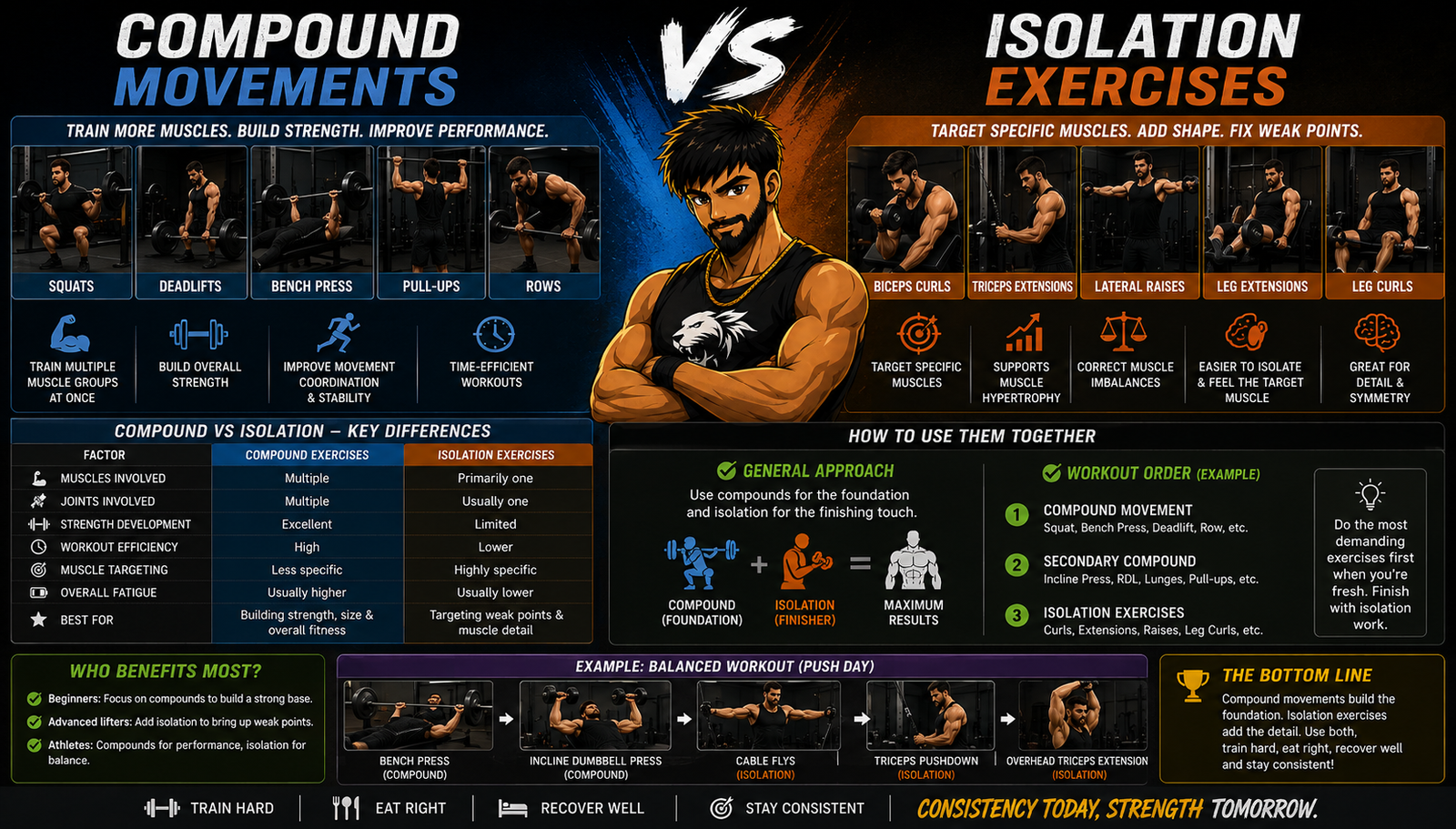
xercises: compound movements and isolation exercises.
Compound exercises train multiple joints and muscle groups at the same time, while isolation exercises primarily focus on one muscle group and involve movement at a single joint.
So, which one should you prioritize?
The answer isn’t necessarily one or the other. A well-designed workout program can use both to build strength, muscle, athletic performance, and a balanced physique.
What Are Compound Movements?
Compound movements are exercises that involve multiple joints and several muscle groups working together.
Some popular examples include:
- Squats
- Deadlifts
- Bench press
- Overhead press
- Pull-ups
- Rows
- Lunges
- Dips
For example, the barbell squat primarily targets the quadriceps and glutes while also requiring significant involvement from the hamstrings, core, and other stabilizing muscles.
Similarly, the bench press primarily trains the chest but also involves the triceps and shoulders.
Benefits of Compound Exercises
1. Train Multiple Muscles at Once
One of the biggest advantages of compound exercises is efficiency.
Instead of training individual muscles separately, one movement can stimulate several muscle groups.
For example:
Squat → Quads + Glutes + Hamstrings + Core
Bench Press → Chest + Triceps + Shoulders
Pull-Up → Back + Biceps + Core
This makes compound exercises particularly useful when you have limited time to train.
2. Build Strength
Compound movements are excellent for developing overall strength because they allow you to move relatively heavy loads while coordinating multiple muscles.
Exercises such as squats, deadlifts, presses, and rows can form the foundation of a strength-training program.
3. Improve Movement Coordination
Compound exercises require different muscles to work together.
This can improve your ability to coordinate movement and maintain stability under load.
That can be particularly useful for athletes and people who want their training to carry over into real-world physical activities.
4. Make Workouts More Time-Efficient
If you only have 45–60 minutes to train, compound movements allow you to get a significant amount of work done in relatively few exercises.
A workout consisting of squats, rows, presses, and pull-ups can train most major muscle groups without requiring dozens of exercises.
What Are Isolation Exercises?
Isolation exercises are movements designed to place greater emphasis on one primary muscle group, usually through movement at a single joint.
Common examples include:
- Biceps curls
- Triceps extensions
- Lateral raises
- Leg extensions
- Leg curls
- Calf raises
- Leg raises
- Pec-deck flyes
For example, a biceps curl primarily involves movement at the elbow and places most of the training emphasis on the biceps.
A leg extension focuses primarily on the quadriceps.
Benefits of Isolation Exercises
1. Target Specific Muscles
Isolation exercises are extremely useful when you want to give additional attention to a particular muscle.
For example, if your shoulders are lagging behind other muscle groups, exercises such as lateral raises can provide additional direct training.
2. Useful for Muscle Hypertrophy
Muscle growth is influenced by factors such as training volume, effort, exercise selection, and progressive overload.
Isolation exercises allow you to accumulate additional training volume for a muscle without necessarily adding substantial fatigue to other muscle groups.
For example, after completing heavy pressing exercises, you can use triceps extensions to give the triceps additional direct work.
3. Address Muscle Imbalances
Isolation exercises can be useful when one muscle group is noticeably weaker or less developed than another.
For example:
- Weak biceps → curls
- Underdeveloped lateral delts → lateral raises
- Weak hamstrings → leg curls
- Underdeveloped calves → calf raises
4. Easier to Control the Target Muscle
Because fewer joints and muscle groups are involved, isolation exercises can make it easier to focus on the intended muscle.
This can be particularly useful for beginners learning how to establish control and for experienced lifters trying to maximize stimulus to a specific muscle.
Compound vs Isolation: Key Differences
| Factor | Compound Exercises | Isolation Exercises |
|---|---|---|
| Muscles involved | Multiple | Primarily one |
| Joints involved | Multiple | Usually one |
| Strength development | Excellent | Limited |
| Workout efficiency | High | Lower |
| Muscle targeting | Less specific | Highly specific |
| Overall fatigue | Usually higher | Usually lower |
| Useful for beginners | Yes | Yes |
| Useful for advanced lifters | Yes | Yes |
| Correcting weak points | Less targeted | Excellent |
Which Is Better for Muscle Growth?
This is where the debate becomes interesting.
Compound exercises are not automatically better for hypertrophy, and isolation exercises are not automatically better either.
Muscle growth depends on providing the target muscles with sufficient training stimulus and recovering from that training.
Compound exercises can provide a lot of stimulus efficiently.
However, they don’t always train every muscle equally.
For example, your triceps may work hard during the bench press, but adding direct triceps extensions can provide additional stimulus without requiring another heavy compound movement.
This is why combining both approaches can be highly effective.
Compound Movements vs Isolation for Beginners
For beginners, compound movements are generally a great starting point.
Learning movements such as:
- Squatting
- Pressing
- Pulling
- Hinging
- Lunging
can help establish basic strength and movement skills.
However, beginners don’t need to avoid isolation exercises.
Adding exercises such as curls, lateral raises, calf raises, or triceps extensions can make training more enjoyable and help develop specific muscles.
The key is not to make the workout unnecessarily complicated.
Compound Movements vs Isolation for Advanced Lifters
As you become more experienced, isolation exercises can become increasingly valuable.
An advanced lifter may already have significant strength and muscle mass from years of compound training. At that stage, adding targeted isolation work can help bring up weaker muscle groups.
For example:
Chest: Bench press + incline press + cable fly
Shoulders: Overhead press + lateral raise + rear-delt fly
Legs: Squat + Romanian deadlift + leg extension + leg curl
The compounds provide the foundation, while isolation exercises help refine the program.
Should You Do Compound or Isolation Exercises First?
In most workouts, exercises that require the most coordination and strength are performed earlier.
A common structure is:
1. Compound movement
Squat, bench press, deadlift, row, etc.
2. Secondary compound movement
Incline press, Romanian deadlift, lunges, etc.
3. Isolation exercises
Curls, extensions, lateral raises, leg curls, etc.
This approach allows you to perform technically demanding movements when you’re relatively fresh and finish with exercises that are easier to control under fatigue.
However, this isn’t a strict rule.
If bringing up a particular muscle is your highest priority, you may intentionally place an isolation exercise earlier in the workout.
Are Compound Exercises Better for Fat Loss?
Compound exercises can be useful during fat loss because they allow you to train multiple muscle groups efficiently.
However, fat loss primarily comes from maintaining a calorie deficit over time.
Exercise helps increase energy expenditure and resistance training helps preserve muscle, but no particular exercise automatically burns body fat.
A combination of resistance training, appropriate nutrition, daily activity, and adequate recovery is more important than choosing compound exercises exclusively.
The Best Approach: Use Both
Instead of asking:
“Compound or isolation?”
A better question is:
“How can I use both effectively?”
A balanced workout could look like this:
Chest & Triceps
- Bench Press — Compound
- Incline Dumbbell Press — Compound
- Cable Fly — Isolation
- Triceps Pushdown — Isolation
- Overhead Triceps Extension — Isolation
Back & Biceps
- Pull-Ups — Compound
- Barbell Row — Compound
- Lat Pulldown — Compound
- Dumbbell Curl — Isolation
- Hammer Curl — Isolation
Legs
- Squat — Compound
- Romanian Deadlift — Compound
- Leg Press — Compound
- Leg Extension — Isolation
- Leg Curl — Isolation
- Calf Raise — Isolation
This combination provides both broad muscle stimulation and targeted work.
Final Verdict
Compound movements build the foundation. Isolation exercises add the detail.
Compound exercises are excellent for building overall strength, training multiple muscles efficiently, and developing fundamental movement patterns.
Isolation exercises are valuable for increasing targeted training volume, bringing up weaker muscles, and developing a balanced physique.
You don’t have to choose one.
For most people, the best resistance-training program combines compound movements as the foundation and isolation exercises as complementary work.
And remember: the exercise itself is only part of the equation. Progressive overload, sufficient training volume, proper technique, nutrition, sleep, and consistency ultimately determine how much progress you make.
Train the big movements. Target the weak points. Recover well. Stay consistent.



Leave a Reply